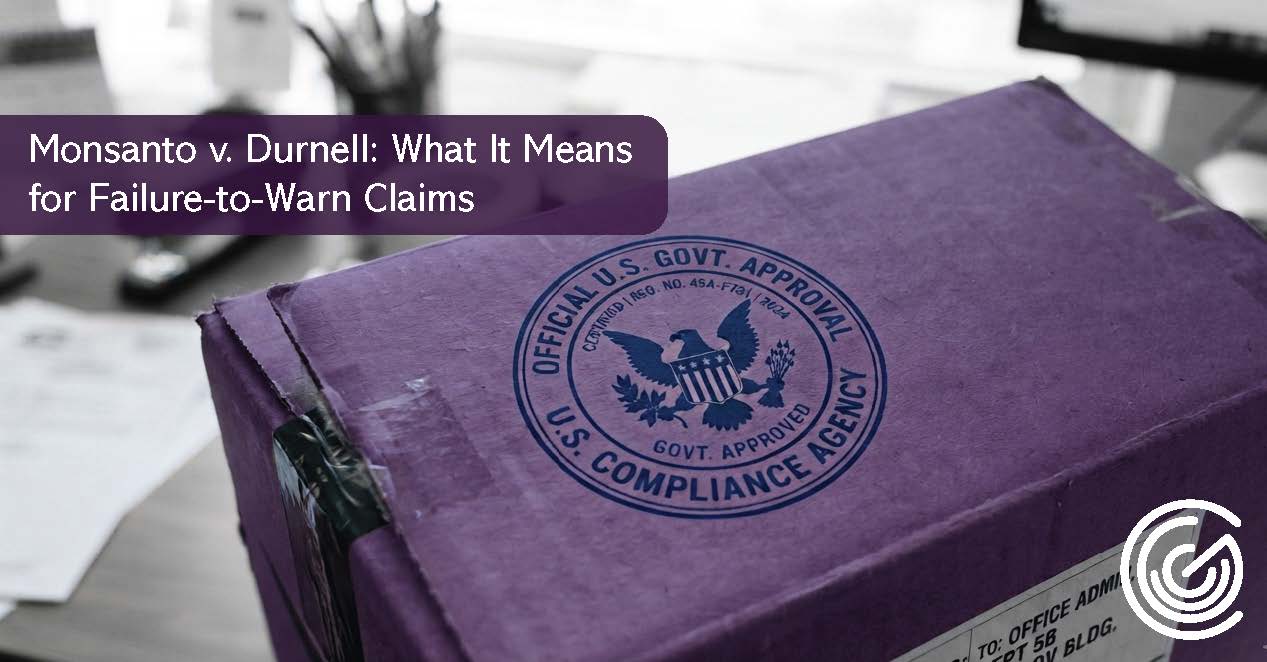
On June 25, 2026, the United States Supreme Court issued a significant decision in Monsanto Co. v. Durnell, finding that federal approval of a pesticide product label shields manufacturers from state-law failure-to-warn claims. Manufacturers of any product subject to federal labeling or registration requirements should understand what it means as this decision’s reasoning reaches well beyond pesticides.
Background of the Case
John Durnell sued Monsanto in Missouri state court, alleging that decades of exposure to Roundup, a glyphosate-based herbicide, caused his non-Hodgkin's lymphoma. Durnell’s failure-to-warn claim alleged that Monsanto should have included a cancer warning on Roundup's label. A Missouri jury agreed and awarded him $1.25 million in damages.
Monsanto's defense centered on the preemption clause in the Federal Insecticide, Fungicide, and Rodenticide Act (FIFRA), which requires pesticide manufacturers to use labeling approved by the Environmental Protection Agency (EPA). The EPA has evaluated glyphosate's cancer risk repeatedly since the 1990s and has not required a cancer warning on product labels. As a result, Monsanto argued that FIFRA's express preemption clause barred a state tort claim seeking to impose a warning the federal regulator had specifically rejected.
The Court's Holding
FIFRA's preemption language prohibits state tort claims from imposing labeling requirements "in addition to or different from" those required under FIFRA. Once the EPA approves a label, the manufacturer is legally obligated to use that exact label unless and until EPA approves or requires a change. A state-law claim demanding a different label, such as one with a cancer warning the EPA never required, imposes a requirement that is "different from" the federal one, and is therefore preempted. As a result, the Supreme Court agreed with Monsanto and reversed the judgment relating to the Missouri jury award in favor of Durnell.
Why This Matters Beyond Pesticides
The Supreme Court noted that FIFRA's preemption clause is not unusual in federal regulations. Several other federal statutes for regulated products contain similarly worded clauses. The Supreme Court made comparisons between the Food and Drug Administration (FDA) and EPA, recognizing that both agencies work with nearly identical regulatory frameworks for product label approval.
For manufacturers of products subject to a federal registration or premarket approval process, this decision strengthens the argument that state-law tort claims seeking different warnings, labels, or packaging than what the federal agency approved may be preempted, provided the governing statute has comparable preemption language and the agency's approval was specific to the safety issue at hand.
This decision is not a complete shield to liability. Several types of state-law tort claims still exist beyond failure-to-warn claims.
GCKB's Product Liability Practice Group will be watching closely as lower courts start applying this decision in the months ahead, particularly in cases involving other federally regulated products. If you have questions about how this decision might affect your labeling strategy, regulatory approach, or a pending or anticipated claim, please reach out to our team at GCKB.
Tags: