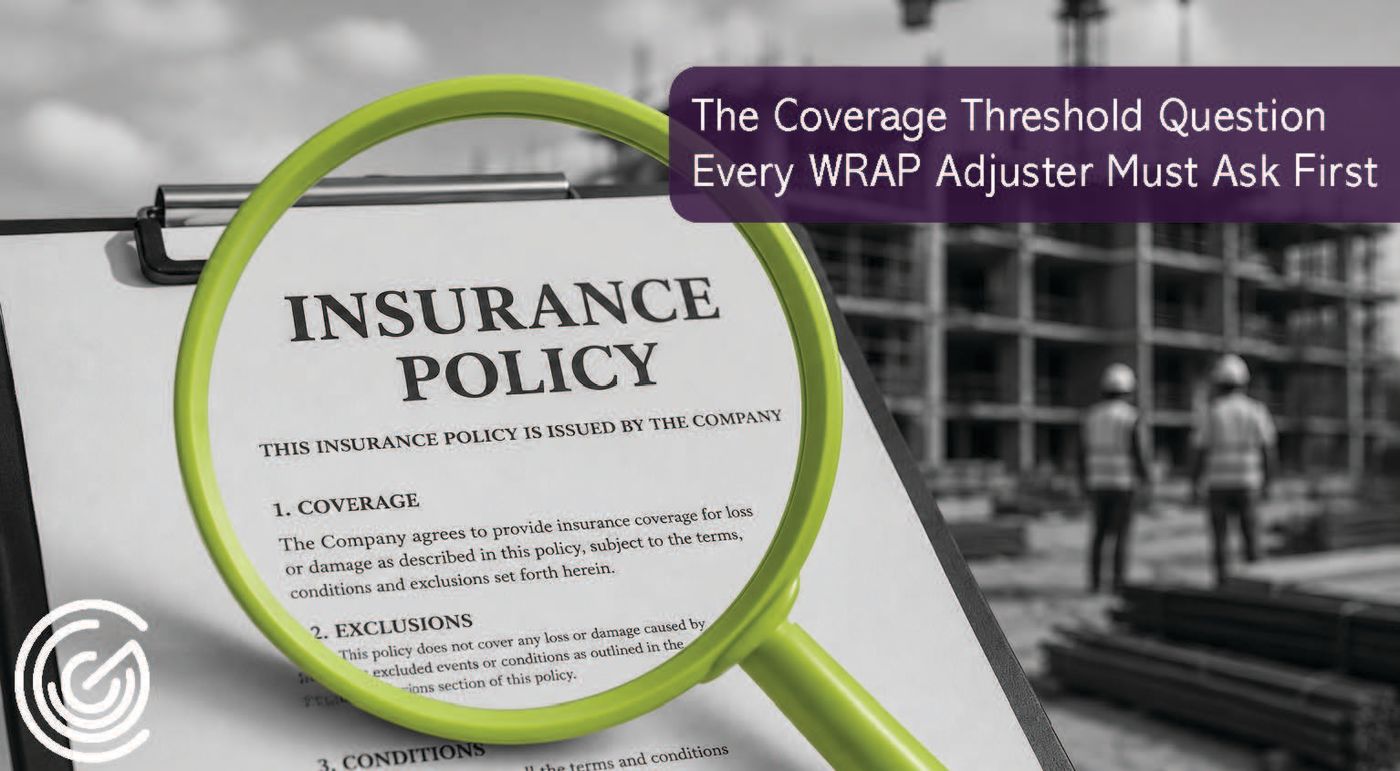
In WRAP claims handling, there is one question that should be answered before any compensability decision, reserve discussion, or litigation strategy is considered:
Does the WRAP actually apply to this claim?
It sounds simple, but experienced WRAP adjusters know that coverage is often the most important, and most overlooked, issue in a construction claim. When coverage assumptions are made too early, carriers can find themselves managing claims that were never intended to fall within the WRAP program, creating unnecessary costs, disputes, and exposure.
For insurance companies handling Owner-Controlled Insurance Programs (OCIPs) and Contractor-Controlled Insurance Programs (CCIPs), the coverage determination must always be the first step in the claims process.
The Most Important Rule: Look at the Policy
One of the key lessons in WRAP claims management is surprisingly straightforward:
Look at the policy.
Not the certificate of insurance. Not project assumptions. Not what someone believes was intended.
The actual WRAP policy controls coverage.
Every claim should begin with a careful review of:
Policy language
Definitions
Endorsements
Enrollment requirements
Project boundaries
Named insured provisions
A certificate of insurance may confirm participation in a project, but it does not establish coverage. The policy itself determines whether an injury falls within the WRAP program.
Before moving forward with claim administration, adjusters should verify that the injured worker, employer, project location, and circumstances of loss satisfy the policy requirements.
The Four Coverage Questions Every Adjuster Should Answer
When evaluating a WRAP claim, adjusters should focus on four threshold questions:
1. Where Did the Injury Occur?
Location matters.
Most WRAP programs are designed around specific project sites and designated operations. Coverage is generally tied to defined project boundaries rather than simply the existence of a construction contract.
Typically covered areas include:
Inside the project fence line
Controlled access work zones
Approved staging areas
Designated laydown yards included in the policy
However, many claims arise in gray areas where coverage is less obvious.
2. When Did the Injury Occur?
Timing can be just as important as location.
Adjusters should determine whether the alleged injury occurred:
During an active WRAP coverage period
After enrollment was completed
While covered operations were being performed
Claims involving injuries before formal enrollment or outside the project period frequently raise significant coverage concerns.
3. Does the Policy Language Support Coverage?
Even where a worker is enrolled and the injury occurs near the project, policy language ultimately controls the outcome.
Coverage determinations should always be tied back to the actual policy wording, endorsements, and applicable exclusions.
Understanding Coverage Boundaries
One of the most common sources of WRAP disputes involves physical and operational boundaries.
While every policy is different, WRAP coverage generally applies to work conducted within defined project operations.
Activities Typically Covered
Most WRAP policies generally contemplate coverage for work performed within:
The project fence line
Controlled access areas
Approved staging locations
Included laydown and material storage areas
These locations are typically identified in project documents and policy endorsements.
Activities Often Excluded
Many WRAP programs exclude activities that occur outside project operations, including:
Off-site fabrication facilities
Warehouse operations
Contractor yard activities
Vendor delivery operations
Work performed before enrollment
Other non-project locations not specifically included under the policy
These distinctions become especially important when investigating injuries involving transportation, material handling, or prefabrication work.
The Gray Areas That Challenge Adjusters
Not every claim fits neatly into a coverage box.
Certain project environments create unique WRAP coverage issues that require deeper investigation.
Mixed-Use Facilities
Projects performed at airports, hospitals, universities, convention centers, and Industrial campuses, often involve areas that are partially controlled by the project and partially controlled by ongoing operations.
Determining whether an injury occurred within the WRAP footprint can require detailed site analysis.
Traffic Control and Flagging Operations
Claims involving traffic management personnel frequently raise questions regarding:
Project-related operations
Roadway control responsibilities
Geographic coverage limits
The work may support the project, but that does not automatically mean it falls within WRAP coverage.
Clerical vs. Trade Employees
Some policies distinguish between clerical employees and field personnel.
Adjusters should confirm the worker's actual job duties at the time of injury rather than relying solely on job titles.
Occupational Disease and Repetitive Stress Claims
Gradual injuries create additional challenges because exposure may occur over multiple locations, employers, or time periods.
Determining whether sufficient exposure occurred within WRAP-covered operations requires careful factual and legal analysis.
Why Coverage Analysis Must Come Before Claims Handling
A strong investigation is important, but even the best liability and medical analysis cannot fix a flawed coverage determination.
Before focusing on:
Compensability
Medical management
Return-to-work planning
Settlement strategy
Litigation defense
the adjuster must first establish that the claim belongs within the WRAP program.
This requires understanding both:
The policy, including all endorsements and enrollment requirements.
The site, including project layout, operational boundaries, and controlled-access areas.
Successful WRAP adjusters develop a working knowledge of each project's physical footprint and operational structure. They know where the project begins, where it ends, and which activities are intended to be covered.
The Bottom Line
The most effective WRAP adjusters resist the temptation to assume coverage.
Instead, they start every file with a simple but critical question:
Does the WRAP apply?
The answer requires reviewing enrollment status, injury location, timing, project operations, and—most importantly—the policy itself.
For insurance companies managing OCIP and CCIP programs, early coverage analysis reduces disputes, improves claim outcomes, and protects the integrity of the WRAP program.
Because when it comes to WRAP claims, the first investigation should never be the injury.
The first investigation should be coverage.
Know the policy. Know the site. Then adjust the claim.
WRAP coverage determinations are rarely as straightforward as they first appear. A careful review of the policy, enrollment status, project boundaries, and site operations can make all the difference in achieving the right outcome. If you'd like to discuss WRAP claims, coverage challenges, or best practices for managing OCIP and CCIP programs, we'd welcome the opportunity to connect.
Tags: