Slip-and-fall claims and sidewalk defect cases are among the most common — and most misunderstood — sources of liability exposure for property owners, businesses, and their insurers. The legal landscape is more nuanced than most people realize, and the difference between a defensible case and a costly settlement often comes down to early fact-gathering, a clear understanding of who actually owns the duty, and knowing which legal doctrines apply. Below, we walk through the key concepts that drive these cases, drawn from our attorneys' deep experience litigating premises and municipal liability matters.
The Foundation: Control Determines Liability
When a premises liability claim lands on your desk, the first question is not whether someone fell — it is who had ownership, occupation, or control of the property, and who had a duty to maintain it. These are not always the same party. A property owner may have leased responsibility to a tenant. A management company may be the true decision-maker for repairs. A maintenance contractor may have introduced the hazardous condition in the first place.
Getting these facts right early — and locking them down with documentation — is essential. That means obtaining lease agreements, management contracts, maintenance records, incident reports, and any video footage. In today's world, video evidence increasingly drives litigation outcomes. If footage exists, it needs to be preserved immediately.
No Dangerous Condition, No Case
Premises liability requires a dangerous or defective condition. Without one, there is no viable claim — and courts are willing to dismiss cases at the summary judgment stage when the evidence does not support a finding of actual danger. Historical photographs can be particularly powerful here. Google Street View images from the past five to ten years can show whether an alleged defect existed long before the incident, and in what condition. That evidence cuts both ways: it can establish notice against a property owner, or it can demonstrate that no defect existed at all.
The Trivial Defect Doctrine: Small Defects, Big Consequences
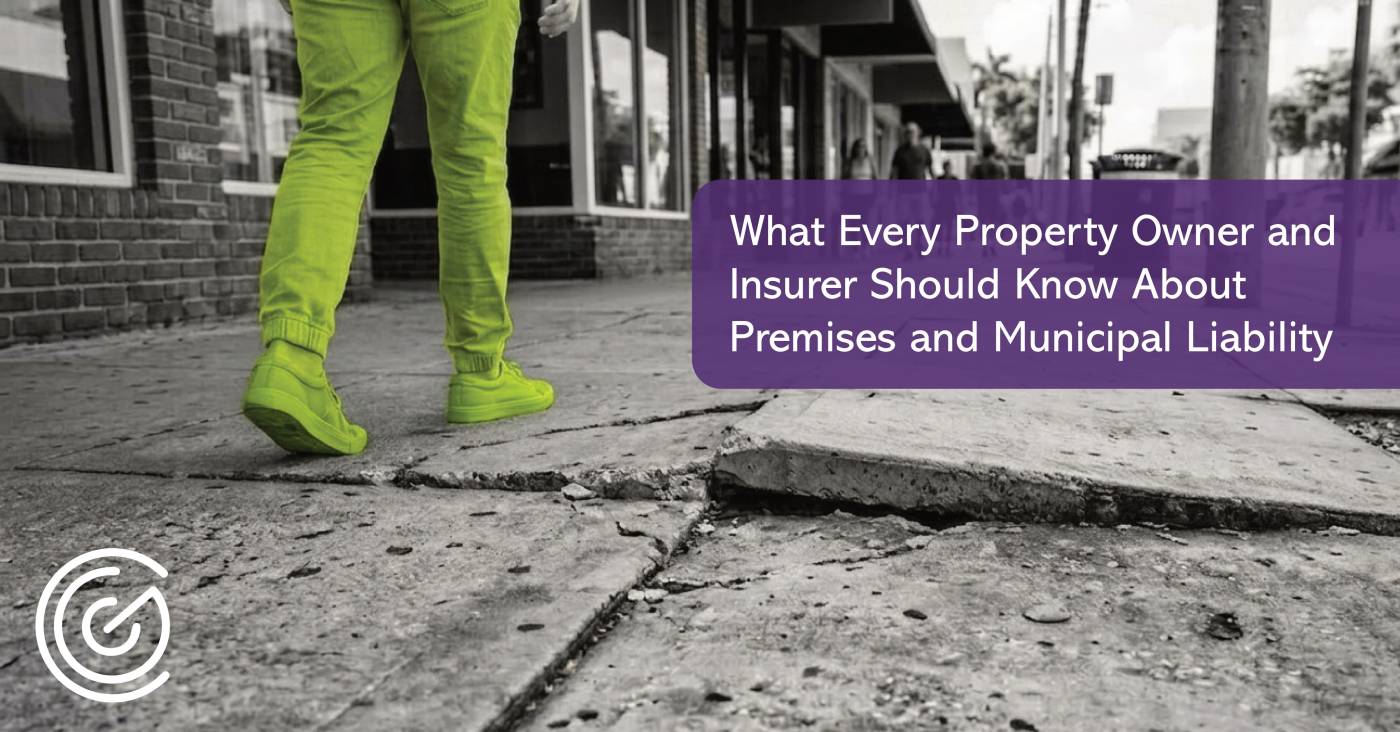
Not every crack in a sidewalk gives rise to liability. Under New York law — as established in Hutchinson v. Sheridan Hill House Corp. — courts consider the totality of circumstances, not just the size of a defect. A minor elevation difference may be trivial if it is clearly visible and poses no additional hazard. But that same defect may become actionable if it has existed for years, is hidden by debris or shadows, or exists in a context that makes it more dangerous than it appears.
In one recent matter, a three-quarter inch sidewalk elevation that might have seemed minor was found actionable because historical images showed it had existed for five to ten years — establishing the property owner had constructive notice. The lesson for insurers evaluating reserves: do not assume small dimensions mean small liability.
Sidewalk Liability: It Depends Where You Are
One of the most common misconceptions in premises cases is assuming a uniform rule for sidewalk responsibility. In New York City, Administrative Code Section 7-210 places liability for sidewalk defects squarely on commercial property owners. Residential owners of one-to-three family, owner-occupied properties are generally exempt — unless they created the condition. Tenants, similarly, bear no liability unless they caused the defect.
Outside New York City, the analysis shifts considerably. Village and town codes must contain explicit liability-creating language to impose responsibility on an adjacent property owner. Without that language, liability may not attach at all — a distinction that can mean the difference between full exposure and a complete defense.
One distinction that trips up many litigants and adjusters: curbs and tree wells are not sidewalks under the Administrative Code. They remain the City's responsibility — which opens the door to municipal liability arguments and written notice defenses that can lead to dismissal against private defendants entirely.
Open and Obvious Conditions: A Nuanced Defense
When a hazardous condition is open and obvious, it can eliminate a property owner's duty to warn. But it does not eliminate the duty to maintain — if the condition is inherently dangerous, the owner may still face liability for failing to repair it. Wheel stops in parking lots, slightly elevated boardwalk edges, and other non-defective but visible conditions have been found not actionable. Significant sidewalk breaks and deteriorating surfaces often are. The distinction matters significantly when evaluating coverage positions and defense strategy.
Out-of-Possession Landlords and Lease Provisions
A landlord who no longer controls day-to-day operations of a property — and whose lease assigns maintenance obligations to the tenant — may avoid liability entirely, provided no structural defect is involved. When the lease places responsibility on the tenant, not only does the landlord gain a defense, but the tenant may owe contractual indemnification and be obligated to provide additional insured coverage to the owner.
For insurers, this means a thorough review of lease agreements is critical early in the claims process. Indemnification provisions and additional insured endorsements can dramatically reshape who ultimately bears the financial burden of a loss.
Municipal Liability: A Different Playbook
When a municipality is involved — as a property owner, road maintainer, or traffic control authority — the legal framework changes substantially. Plaintiffs must file a Notice of Claim within 90 days of the incident. Courts may grant leave for late filings up to one year and 90 days, but municipalities gain substantial protection from this requirement, and many claims are barred outright for failure to comply.
Beyond notice requirements, municipalities benefit from a Prior Written Notice defense for sidewalk and roadway defects. Unless the municipality created the defect or performed negligent repairs, it cannot be held liable without documented prior written notice of the specific condition. In practice, this defense leads to dismissal in a significant number of cases — particularly where a curb or roadway defect has been mischaracterized as a sidewalk defect, or where no written complaints appear in the municipality's records.
For traffic-related claims, municipalities may also claim qualified immunity — but only if they conducted a reasonable traffic study and based their decisions on that study. A failure to study the specific hazard at issue can negate immunity and expose the municipality to full liability.
Article 16 and Limiting Exposure
New York's Article 16 provides meaningful protection to defendants found 50% or less responsible for an injury. Under this framework, a partially liable defendant pays only their proportionate share of non-economic damages — pain and suffering — rather than the full amount. Special damages, including medical bills and lost wages, remain subject to joint and several liability. For insurers managing multi-defendant cases, Article 16 arguments deserve serious attention at both the pleading and trial strategy stages.
New Jersey: A Different Standard
For those operating or insuring properties in New Jersey, the rules differ meaningfully. Residential property owners bear no duty to maintain adjacent sidewalks. However, commercial property owners and tenants with exclusive control face a non-delegable duty — meaning they cannot contract away responsibility by hiring a maintenance vendor. Businesses must also conduct reasonable inspections based on their operations. The extent of sidewalk liability in New Jersey depends heavily on property use and who holds actual control.
The Bottom Line for Business Leaders and Insurers
Premises and municipal liability cases reward early, thorough investigation. The parties who act quickly — preserving video, pulling historical photographs, reviewing lease language, and identifying the right municipal records — consistently achieve better outcomes. The parties who wait often find that critical evidence has disappeared, notice defenses are waived, and exposure has grown.
At Gerber Ciano Kelly Brady, our attorneys handle these cases from initial assessment through trial, with a focus on identifying the strongest available defenses and managing exposure strategically. If you have questions or want to discuss how these principles apply to your portfolio, we welcome the conversation. Contact us today.